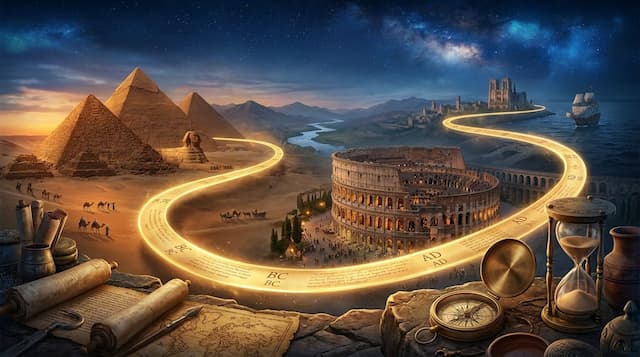
Introduction
History is not merely a collection of dusty dates and forgotten treaties—it is the epic story of how humanity evolved from isolated bronze-age settlements along muddy river valleys into a globally interconnected civilization capable of exploring outer space and mapping the code of life.
Studying world history provides the ultimate lens for understanding current geopolitical conflicts, democratic institutions, economic systems, and human nature itself. When you realize that the legal debates of ancient Rome or the supply disruptions of the Silk Road mirror modern global events, the past comes vibrantly alive.
We have curated exactly 100 high-yield trivia and competition-grade history questions organized chronologically into five balanced rounds of 20 questions each. Whether you are preparing for a pub trivia championship, studying for academic exams, or simply love history, enjoy this comprehensive interactive challenge!
Part 1: Ancient Civilizations & Antiquity (Qs 1–20)
From the fertile crescent of Sumer and the banks of the Nile to the Acropolis of Athens and the Roman Forum, ancient civilizations laid down our alphabets, mathematics, legal codes, and architectural marvels.
Test your knowledge on pharaohs, philosophers, emperors, and the seven wonders of the ancient world.
Explore the cradle of civilization: Mesopotamia, Egypt, ancient Greece, Rome, the Silk Road, and early empires.
Who was the first Emperor of a unified China in 221 BC?
Show all 20 questions and answers
Who was the first Emperor of a unified China in 221 BC?
Answer: Qin Shi Huang
Qin Shi Huang unified the Warring States in 221 BC, standardized Chinese script and measurements, built the initial Great Wall, and was buried with the Terracotta Army.
What ancient stone artifact uncovered in 1799 unlocked the decipherment of Egyptian hieroglyphs?
Answer: The Rosetta Stone
Carved in 196 BC, the Rosetta Stone contained identical decree text in Hieroglyphic, Demotic, and Ancient Greek, decoded by Jean-François Champollion in 1822.
Which war between Athens and Sparta devastated ancient Greece between 431 BC and 404 BC?
Answer: The Peloponnesian War
Chronicled by historian Thucydides, the Peloponnesian War ended with Sparta tearing down the Long Walls of Athens and dismantling the Delian League.
Who was the Carthaginian general who led war elephants across the Alps to invade Rome in 218 BC?
Answer: Hannibal Barca
Hannibal won legendary tactical victories at Trebia, Lake Trasimene, and Cannae during the Second Punic War before being defeated at Zama in 202 BC.
What is the oldest known surviving work of epic literature in human history?
Answer: The Epic of Gilgamesh
Originating in ancient Mesopotamia around 2100 BC, the Epic of Gilgamesh chronicles the mythical adventures and mortality quest of King Gilgamesh of Uruk.
Which Roman general and statesman was assassinated on the Ides of March (March 15, 44 BC)?
Answer: Julius Caesar
Caesar was assassinated by a conspiracy of Roman senators led by Marcus Junius Brutus and Gaius Cassius Longinus in the Theatre of Pompey.
What wonder of the ancient world was reportedly built in Babylon by King Nebuchadnezzar II for his homesick wife?
Answer: The Hanging Gardens of Babylon
According to Greek accounts, Nebuchadnezzar II built the tiered gardens for Queen Amytis of Media, who missed the verdant mountains of her homeland.
Who was the last active ruler of Ptolemaic Egypt before it was annexed as a Roman province?
Answer: Cleopatra VII
Cleopatra VII aligned with Julius Caesar and later Mark Antony before her suicide in 30 BC following their naval defeat at the Battle of Actium.
What ancient overland trade network connected Han Dynasty China with the Mediterranean basin?
Answer: The Silk Road
Expanded during the Han Dynasty under envoy Zhang Qian, the Silk Road facilitated commerce, religion, philosophy, and technology across Eurasia.
Which Macedonian king conquered the Persian Empire and established an empire stretching to India by age 30?
Answer: Alexander the Great
Tutored by Aristotle, Alexander remained undefeated in battle, founded dozens of cities named Alexandria, and died in Babylon in 323 BC.
What ancient civilization constructed the cliff-top royal citadel of Machu Picchu in the Andes mountains?
Answer: The Inca Empire
Constructed around 1450 AD under Inca Emperor Pachacuti, Machu Picchu sits at 2,430 meters altitude and was brought to global acclaim by Hiram Bingham in 1911.
Which Roman Emperor legalized Christianity across the empire with the Edict of Milan in 313 AD?
Answer: Constantine the Great
Constantine the Great halted persecution of Christians, convened the First Council of Nicaea (325 AD), and relocated the capital to Constantinople in 330 AD.
What ancient legal text from Babylonia established the famous retributive justice principle of "an eye for an eye"?
Answer: The Code of Hammurabi
Inscribed on an eight-foot black basalt stele around 1750 BC, the Code of Hammurabi contained 282 codified laws governing contracts, property, and civil rights.
Which Athenian philosopher was sentenced to death in 399 BC for "corrupting the youth" and impiety?
Answer: Socrates
Socrates was condemned by an Athenian jury to drink poison hemlock, refusing opportunities to flee as recorded in Plato's *Apology* and *Crito*.
What ancient civilization developed the earliest known writing system (cuneiform) around 3400 BC?
Answer: The Sumerians
Sumerians in southern Mesopotamia pressed wedge-shaped reed styluses into wet clay tablets, creating the world's oldest verified script for administrative accounting.
What catastrophic volcanic eruption buried the Roman cities of Pompeii and Herculaneum in 79 AD?
Answer: Mount Vesuvius
Mount Vesuvius buried Pompeii under meters of pumice and volcanic ash, freezing daily Roman life in time until its rediscovery in the 18th century.
According to Roman foundation myth, who was the legendary founder and first king of Rome in 753 BC?
Answer: Romulus
Mythology states twin orphans Romulus and Remus were nursed by a she-wolf (*Lupa*). Romulus founded the city on the Palatine Hill after slaying Remus.
For which Egyptian pharaoh was the Great Pyramid of Giza constructed around 2560 BC?
Answer: Khufu (Cheops)
Khufu of the Fourth Dynasty commissioned the Great Pyramid. Composed of approximately 2.3 million stone blocks, it was the tallest man-made structure for 3,800 years.
Which Persian king founded the Achaemenid Empire and freed Jewish captives in Babylon in 539 BC?
Answer: Cyrus the Great
Cyrus the Great issued the Cyrus Cylinder, granting religious freedom and allowing displaced peoples to return home, earning him praise even in the Hebrew Bible.
What ancient naval battle in 480 BC saw allied Greek triremes decisively defeat Xerxes' Persian invasion fleet?
Answer: The Battle of Salamis
Strategist Themistocles lured the unwieldy Persian fleet into the cramped straits of Salamis, where agile Greek warships rammed and destroyed over 200 Persian vessels.
Teaching at the University of Oxford began around 1096 AD, making it several centuries older than the Aztec Empire, which was founded in 1428 AD when Tenochtitlan united with Texcoco and Tlacopan.
Part 2: Middle Ages, Renaissance & Global Empires (Qs 21–40)
The millennium bridging the collapse of Western Rome and the Age of Discovery witnessed the rise of dynamic Islamic caliphates, the spread of the Pax Mongolica, feudal chivalry, and the intellectual rebirth of the Italian Renaissance.
See how well you know Gutenberg’s printing press, Copernicus’s celestial spheres, and the global voyage of Magellan.
Journey through the Carolingian Empire, Black Death, Islamic Golden Age, Mongol expansions, and Renaissance polymaths.
Who was crowned Emperor of the Romans by Pope Leo III on Christmas Day in 800 AD?
Show all 20 questions and answers
Who was crowned Emperor of the Romans by Pope Leo III on Christmas Day in 800 AD?
Answer: Charlemagne (Charles the Great)
Charlemagne united Western and Central Europe during the Early Middle Ages, laying the foundations for both modern France and Germany.
What devastating pandemic swept across Europe from 1346 to 1353, killing 30% to 60% of the population?
Answer: The Black Death (Bubonic Plague)
Caused by the bacterium *Yersinia pestis* carried by rat fleas on merchant ships, the Black Death drastically disrupted European feudal economics and labor.
Which French peasant heroine led armies against the English in the Hundred Years' War before being martyred in 1431?
Answer: Joan of Arc
Joan of Arc lifted the Siege of Orléans at age 17, enabling Charles VII's coronation. Captured by Burgundians, she was burned at the stake in Rouen and canonized in 1920.
Who founded the Mongol Empire in 1206, establishing the largest contiguous land empire in world history?
Answer: Genghis Khan (Temüjin)
Genghis Khan united nomadic steppe tribes through meritocratic military organization, creating an empire spanning from the Sea of Japan to Eastern Europe.
What English king broke with the Roman Catholic Church in 1534 to establish the Church of England?
Answer: Henry VIII
Denied an annulment of his marriage to Catherine of Aragon by Pope Clement VII, Henry VIII passed the Act of Supremacy, declaring himself Supreme Head of the Church.
What 1066 battle saw Norman forces under William the Conqueror defeat Anglo-Saxon King Harold Godwinson?
Answer: The Battle of Hastings
The Battle of Hastings inaugurated Norman rule in England, fundamentally reshaping the English language, aristocracy, and legal system, as chronicled in the Bayeux Tapestry.
Who printed the first movable-type metal Latin Bible in Mainz, Germany around 1455?
Answer: Johannes Gutenberg
Johannes Gutenberg invented the oil-based ink, metal alloy type, and adjustable handheld mold that allowed mass mechanical book reproduction across Europe.
Which Genoese navigator completed four voyages across the Atlantic beginning in 1492 under the Spanish Crown?
Answer: Christopher Columbus
Sponsored by Queen Isabella I and King Ferdinand II, Columbus landed in the Bahamas in October 1492, triggering the permanent Columbian Exchange between hemispheres.
What Islamic empire ruled Southeastern Europe, Western Asia, and North Africa from 1299 until 1922?
Answer: The Ottoman Empire
Founded by Osman I, the Ottoman Empire captured Constantinople in 1453 under Mehmed II and reached its zenith under Suleiman the Magnificent before dissolving post-WWI.
Who ignited the Protestant Reformation in 1517 by posting his Ninety-five Theses in Wittenberg?
Answer: Martin Luther
Martin Luther attacked the sale of papal indulgences and translated the Bible into the German vernacular, transforming European religious and political history.
Which Venetian merchant spent 24 years traveling along the Silk Road and served in the court of Kublai Khan?
Answer: Marco Polo
Marco Polo's memoirs, dictated while imprisoned in Genoa, introduced Western Europe to Chinese innovations including paper currency, coal, and postal relay networks.
What seminal charter signed by King John at Runnymede in 1215 established that the monarch was subject to the law?
Answer: Magna Carta
Clause 39 of Magna Carta established the right of free men to lawful judgment of their peers, serving as the bedrock for modern habeas corpus and constitutional law.
Which Japanese general became Shogun in 1603, launching a dynasty of isolationist peace lasting over 250 years?
Answer: Tokugawa Ieyasu
Following his victory at the Battle of Sekigahara (1600), Tokugawa Ieyasu established the Edo Shogunate and enforced strict social order and national isolation (*Sakoku*).
Which Renaissance polymath painted The Last Supper and Mona Lisa while drafting concept designs for helicopters?
Answer: Leonardo da Vinci
Leonardo da Vinci epitomized the Renaissance Ideal, contributing visionary notebooks on hydrodynamics, optics, anatomy, flight, and fine art.
What naval expedition completed the first verified global circumnavigation between 1519 and 1522?
Answer: The Magellan-Elcano Expedition
Though Ferdinand Magellan was killed in the Philippines in 1521, Basque navigator Juan Sebastián Elcano guided the remaining ship *Victoria* back to Spain with 18 survivors.
Which Spanish conquistador led the military campaign that toppled the Aztec capital of Tenochtitlan in 1521?
Answer: Hernán Cortés
Cortés allied with indigenous Tlaxcalans, smallpox epidemics, and superior steel weaponry to overthrow Aztec Emperor Cuauhtémoc, claiming Mexico for Spain.
What French monarch was nicknamed the "Sun King" (*Le Roi Soleil*) and ruled France for an unmatched 72 years?
Answer: Louis XIV
Louis XIV centralized royal power at the Palace of Versailles, consolidated absolute monarchy, and remains the longest-reigning sovereign in verified world history (1643–1715).
What 15th-century civil conflict for the English throne was fought between the Houses of Lancaster and York?
Answer: The Wars of the Roses
Named after the heraldic red rose of Lancaster and white rose of York, the war concluded at Bosworth Field (1485) when Henry Tudor defeated Richard III to found the Tudor Dynasty.
What Polish astronomer proposed the revolutionary heliocentric model placing the Sun at the center of planetary orbits?
Answer: Nicolaus Copernicus
Copernicus published *De revolutionibus orbium coelestium* on his deathbed in 1543, overturning the Ptolemaic geocentric model and igniting the Scientific Revolution.
Which imperial dynasty commissioned the Taj Mahal in Agra as a white marble mausoleum for Mumtaz Mahal?
Answer: The Mughal Empire
Mughal Emperor Shah Jahan oversaw construction of the Taj Mahal between 1632 and 1653, combining Persian, Indian, and Islamic architectural symmetry.
Cleopatra VII (69 BC – 30 BC) lived closer in time to the 1969 Apollo Moon landing (approx. 2,000 years later) than she did to the construction of the Great Pyramid of Giza (approx. 2,500 years earlier).
Part 3: Revolutions, Empires & Industrialization (Qs 41–60)
Between 1776 and 1914, human society fractured its feudal shackles. Democratic revolutions across the Atlantic overthrew divine monarchs, while James Watt’s steam engine and industrial factory lines radically re-engineered human labor and urbanization.
Examine the pivotal events that dismantled empires and forged modern nation-states.
Witness the American, French, and Haitian revolutions, Napoleonic warfare, steam power, and the 19th-century colonial scramble.
What 1773 colonial protest in Boston saw the Sons of Liberty dump 342 chests of British East India tea into the harbor?
Show all 20 questions and answers
What 1773 colonial protest in Boston saw the Sons of Liberty dump 342 chests of British East India tea into the harbor?
Answer: The Boston Tea Party
Disguised as Mohawk warriors, American colonists destroyed 45 tons of tea to protest taxation without representation, directly precipitating the Revolutionary War.
What medieval fortress and state prison was stormed on July 14, 1789, marking the dawn of the French Revolution?
Answer: The Bastille
The storming of the Bastille symbolized the overthrow of royal despotism and is commemorated annually as France's National Day (Bastille Day).
Who served as the principal author of the United States Declaration of Independence in July 1776?
Answer: Thomas Jefferson
33-year-old Thomas Jefferson drafted the Declaration in Philadelphia, articulating Enlightenment principles of inalienable rights to life, liberty, and happiness.
Which military genius seized control of France in 1799, crowned himself Emperor in 1804, and conquered much of mainland Europe?
Answer: Napoleon Bonaparte
Napoleon established the Napoleonic Code (which still underpins European civil law), conquered continental Europe, and met his final defeat at Waterloo in 1815.
What revolution begun in 1791 became the only successful slave rebellion in history to establish an independent nation?
Answer: The Haitian Revolution
Led by Toussaint Louverture and Jean-Jacques Dessalines, enslaved people in Saint-Domingue defeated British and French colonial armies, declaring Haiti independent in 1804.
Known as "El Libertador," which South American revolutionary leader helped liberate Venezuela, Colombia, Ecuador, Peru, and Bolivia from Spanish rule?
Answer: Simón Bolívar
Simón Bolívar envisioned a united Hispanic South America (Gran Colombia) and served as its president, with the nation of Bolivia named in his honor.
What 1815 battle in modern Belgium marked Napoleon Bonaparte's final military defeat against British and Prussian forces?
Answer: The Battle of Waterloo
The Duke of Wellington and Prussian Field Marshal Blücher routed Napoleon's Imperial Guard at Waterloo on June 18, 1815, resulting in Napoleon's exile to Saint Helena.
What economic transformation that began in Britain in the late 18th century replaced agrarian handcraft with steam engines and factories?
Answer: The Industrial Revolution
Driven by James Watt's steam engine, mechanized textile looms, and cheap coal, the Industrial Revolution fundamentally reshaped urbanization, demographics, and world trade.
Which US President issued the Emancipation Proclamation in 1863 and delivered the Gettysburg Address during the American Civil War?
Answer: Abraham Lincoln
Lincoln preserved the Union, issued the Emancipation Proclamation declaring Confederate slaves free, and championed the 13th Amendment abolishing slavery before his 1865 assassination.
What "Iron Chancellor" utilized diplomacy and three wars to unify Germany into an empire under Kaiser Wilhelm I in 1871?
Answer: Otto von Bismarck
Bismarck executed realpolitik through wars against Denmark, Austria, and France, unifying the German states into a dominant European superpower.
What Chinese uprising between 1850 and 1864, led by Hong Xiuquan against the Qing Dynasty, caused an estimated 20 to 30 million deaths?
Answer: The Taiping Rebellion
The Taiping Rebellion was one of the deadliest conflicts in human history. Hong claimed to be the younger brother of Jesus Christ and established the "Taiping Heavenly Kingdom."
What war (1853–1856) saw Britain, France, and the Ottoman Empire defeat the Russian Empire, famous for Florence Nightingale's medical reforms?
Answer: The Crimean War
Fought on the Black Sea Crimean Peninsula, the war highlighted technological leaps in rifled muskets, telegraphs, war journalism, and military battlefield sanitation.
Which British monarch reigned for 63 years during the zenith of the British Empire, the Industrial Revolution, and global colonial expansion?
Answer: Queen Victoria
Reigning from 1837 to 1901, Queen Victoria gave her name to the Victorian Era, characterized by vast industrialization, railway networks, and the Pax Britannica.
What 1884–1885 conference convened by European powers divided the African continent into colonial spheres without African representation?
Answer: The Berlin Conference
Chaired by Otto von Bismarck, the Berlin Conference launched the "Scramble for Africa," slicing 90% of the continent into European colonial possessions by 1914.
What 1899–1901 anti-foreign and anti-Christian uprising in Qing China was crushed by an Eight-Nation International Alliance?
Answer: The Boxer Rebellion (Yihetuan)
Practitioners of martial arts ("Boxers") besieged foreign legations in Beijing before an alliance of British, Russian, Japanese, French, US, German, Italian, and Austro-Hungarian forces intervened.
What canal opened in Egypt in 1869, connecting the Mediterranean Sea directly to the Red Sea and cutting trade journeys to Asia by weeks?
Answer: The Suez Canal
Engineered by Ferdinand de Lesseps, the 193 km Suez Canal eliminated the dangerous voyage around the Cape of Good Hope, revolutionizing global maritime commerce.
Which American inventor patented the practical incandescent light bulb in 1879 and founded the world's first central investor-owned electric utility?
Answer: Thomas Edison
Holding 1,093 US patents, Edison created Menlo Park research lab, commercialized phonographs, motion picture cameras, and practical electric lighting systems.
What 1904–1905 military conflict marked the first time in modern history that an Asian nation defeated a European great power?
Answer: The Russo-Japanese War
Japan's stunning naval victory under Admiral Togo at the Battle of Tsushima forced Russia to concede Liaodong and Korea, establishing Japan as a global imperial power.
Who was the Mexican revolutionary general who led guerrilla armies in the north alongside Emiliano Zapata in the south (1910–1920)?
Answer: Pancho Villa (Doroteo Arango)
Pancho Villa led the *División del Norte*, famously raided Columbus, New Mexico in 1916, and became a defining folk legend of the Mexican Revolution.
What 1911 revolution in China overthrew the 267-year Qing Dynasty and established the Republic of China under Dr. Sun Yat-sen?
Answer: The Xinhai Revolution
The Xinhai Revolution brought an end to over 2,000 years of imperial dynastic rule in China, inaugurating the Republic of China on January 1, 1912.
A landmark 2003 genetic study revealed that approximately 0.5% of men worldwide (roughly 16 million living men) carry a nearly identical Y-chromosome lineage tracing directly back to Genghis Khan and his close male relatives.
Part 4: World Wars & The Cold War (Qs 61–80)
The 20th century witnessed industrialized warfare on a scale never before imagined. Over 100 million people died across two world wars, prompting the creation of the United Nations and launching the nuclear standoff of the Cold War.
Review the strategies of Stalingrad, D-Day, the Cuban Missile Crisis, and the fall of the Berlin Wall.
Navigate the trenches of WWI, the rise of totalitarianism, WWII battlefronts, atomic dawn, and 45 years of superpower brinkmanship.
Whose assassination in Sarajevo on June 28, 1914 by Gavrilo Princip triggered the outbreak of World War I?
Show all 20 questions and answers
Whose assassination in Sarajevo on June 28, 1914 by Gavrilo Princip triggered the outbreak of World War I?
Answer: Archduke Franz Ferdinand
The murder of Austro-Hungarian heir Franz Ferdinand triggered the July diplomatic crisis, cascading through mutual defense pacts into global total war.
What 1917 revolution in Russia saw Vladimir Lenin's Bolsheviks overthrow the Provisional Government to create a Soviet state?
Answer: The October (Bolshevik) Revolution
Lenin and Leon Trotsky orchestrated the Red Guards' storming of the Winter Palace in Petrograd, leading to Russia's exit from WWI and the establishment of the USSR.
What 1919 peace treaty formally ended World War I, imposing heavy reparations, territorial losses, and demilitarization on Germany?
Answer: The Treaty of Versailles
Signed in the Hall of Mirrors at Versailles, Article 231 (the "War Guilt Clause") placed full responsibility on Germany, breeding resentment that fueled WWII.
What sudden Wall Street stock market collapse on October 29, 1929 ("Black Tuesday") ushered in the worldwide Great Depression?
Answer: The 1929 Wall Street Crash
Billions in equity evaporated in hours as panicked selling wiped out margin accounts, leading to a decade of widespread bank failures and mass unemployment.
What unprovoked military invasion on September 1, 1939 caused Britain and France to declare war on Nazi Germany, igniting World War II?
Answer: The Invasion of Poland
Germany staged a false-flag border incident to launch blitzkrieg operations against Poland, partitioned weeks later with the USSR under the Molotov-Ribbentrop Pact.
What surprise naval air attack on December 7, 1941 propelled the United States into direct combat in World War II?
Answer: The Attack on Pearl Harbor
Imperial Japanese aircraft struck the US Pacific Fleet in Hawaii, sinking or damaging battleships and killing 2,403 Americans. President Roosevelt dubbed it "a date which will live in infamy."
What five-month urban battle in 1942–1943 is considered the bloodiest in human history and the definitive turning point on WWII's Eastern Front?
Answer: The Battle of Stalingrad
With over 2 million casualties, Soviet forces encircled and captured Germany's entire 6th Army under Field Marshal Paulus, permanently putting the Wehrmacht on the defensive.
What Allied amphibious invasion on June 6, 1944 (Operation Overlord) landed 156,000 troops across Normandy beaches to liberate Western Europe?
Answer: D-Day
Commanded by General Dwight D. Eisenhower, Allied American, British, and Canadian forces stormed Utah, Omaha, Gold, Juno, and Sword beaches in northern France.
Which British Prime Minister rallied the nation through the Blitz with speeches declaring "We shall fight on the beaches"?
Answer: Winston Churchill
Churchill took office in May 1940 and rejected peace talks with Hitler, maintaining Britain as a lone bulwark of Western democracy until the US and USSR entered the war.
Which two Japanese cities were destroyed by American atomic bombs ("Little Boy" and "Fat Man") in August 1945?
Answer: Hiroshima and Nagasaki
Dropped by B-29 bombers on August 6 and 9, 1945, the nuclear detonations caused over 150,000 deaths and prompted Emperor Hirohito's surrender on August 15.
What international body of 51 founding states was chartered in San Francisco in October 1945 to prevent future global wars?
Answer: The United Nations (UN)
Formed in the aftermath of WWII, the UN established the Security Council with five permanent members (US, UK, USSR, France, China) possessing veto powers.
What massive US foreign aid initiative poured $13 billion into rebuilding Western European economies between 1948 and 1951?
Answer: The Marshall Plan (European Recovery Program)
Proposed by Secretary of State George Marshall, the funds rebuilt industrial infrastructure, restored commerce, and countered Soviet-backed communist movements in Europe.
What mutual defense military alliance was established by 12 Western nations in Washington D.C. in 1949 to deter Soviet expansion?
Answer: NATO (North Atlantic Treaty Organization)
NATO's foundational Article 5 guarantees that an armed attack against any member in Europe or North America is considered an attack against all.
What 1950–1953 Asian conflict ended with an armistice dividing the peninsula at the 38th parallel with a Demilitarized Zone (DMZ)?
Answer: The Korean War
When North Korea invaded the South, a UN coalition led by General Douglas MacArthur intervened, fighting Chinese and North Korean troops until an armistice halted hostilities without a formal peace treaty.
Who was the anti-colonial leader who led India to independence in 1947 through nonviolent civil disobedience (*Satyagraha*)?
Answer: Mahatma Gandhi
Gandhi pioneered mass nonviolent protests like the 1930 Salt March, inspiring civil rights movements globally from Martin Luther King Jr. to Nelson Mandela.
What October 1962 confrontation between JFK and Nikita Khrushchev brought humanity to the closest point of nuclear war?
Answer: The Cuban Missile Crisis
The discovery of Soviet nuclear ballistic missiles in Cuba resulted in a 13-day naval blockade. Secret negotiations removed Soviet missiles from Cuba and US Jupiter missiles from Turkey.
What 155-kilometer concrete barrier physically divided East and West Berlin from August 1961 until its breach in November 1989?
Answer: The Berlin Wall
Erected by East Germany (GDR) to stop skilled citizens fleeing to the West, its fall on November 9, 1989 became the global icon for the end of the Cold War.
Who was the American civil rights leader who delivered the historic "I Have a Dream" speech at the Lincoln Memorial in 1963?
Answer: Martin Luther King Jr.
King championed peaceful desegregation, voting rights, and economic justice, earning the 1964 Nobel Peace Prize before his assassination in Memphis in 1968.
Which Soviet leader introduced *Glasnost* (openness) and *Perestroika* (restructuring), culminating in the dissolution of the USSR in 1991?
Answer: Mikhail Gorbachev
Gorbachev sought to reform the Soviet economy and reduce Cold War tensions with Ronald Reagan, but his political liberalization unleashed democratic revolutions across the Eastern Bloc.
Who spent 27 years imprisoned on Robben Island before being released in 1990 to become South Africa's first Black President in 1994?
Answer: Nelson Mandela
Mandela led the African National Congress (ANC), negotiated the peaceful end of apartheid with F.W. de Klerk, and was awarded the Nobel Peace Prize in 1993.
Part 5: Modern Era & 21st Century Milestones (Qs 81–100)
The contemporary era is defined by dizzying scientific acceleration and global interconnectedness. Humans walked on the Moon, decoded the human genome, created the internet, and launched artificial intelligence capable of reasoning across human knowledge.
Finish your journey through human history with these 20 defining milestones of our living memory.
From the Apollo 11 lunar touchdown and the World Wide Web to the Human Genome, climate summits, and the generative AI revolution.
On July 20, 1969, who became the first human being to step onto the surface of the Moon during Apollo 11?
Show all 20 questions and answers
On July 20, 1969, who became the first human being to step onto the surface of the Moon during Apollo 11?
Answer: Neil Armstrong
Armstrong declared, "That's one small step for [a] man, one giant leap for mankind" as he stepped onto the Sea of Tranquility, fulfilling JFK's lunar goal.
What British computer scientist invented the World Wide Web at CERN in 1989 by developing HTML, HTTP, and URLs?
Answer: Tim Berners-Lee
Berners-Lee built the first web server and browser to help physicists share research papers, releasing the protocol royalty-free to the world in 1993.
What 1992 treaty signed in the Netherlands founded the European Union and paved the way for the single Euro currency?
Answer: The Maastricht Treaty
The Maastricht Treaty established European citizenship, standard foreign and security policies, and the fiscal criteria for European Economic and Monetary Union.
Which tragedy occurred on September 11, 2001 when 19 al-Qaeda hijackers commandeered four commercial airliners in the US?
Answer: The 9/11 Terrorist Attacks
The attacks destroyed the Twin Towers in New York and damaged the Pentagon, killing 2,977 victims and launching the global "War on Terror" in Afghanistan and Iraq.
Who was elected as the 44th and first African American President of the United States in November 2008?
Answer: Barack Obama
Obama served two terms (2009–2017), enacted the Affordable Care Act, authorized the 2011 raid eliminating Osama bin Laden, and received the 2009 Nobel Peace Prize.
What landmark international climate treaty was negotiated by 196 countries at COP21 in December 2015?
Answer: The Paris Agreement
The Paris Agreement established goals to hold global warming well below 2.0°C above pre-industrial levels, aiming for 1.5°C through nationally determined contributions.
What country held a historic referendum in June 2016 voting 51.9% to leave the European Union ("Brexit")?
Answer: The United Kingdom
Following decades of Euroskeptic debate, British voters chose to withdraw from the EU, formally completing the departure on January 31, 2020.
Who served as Chancellor of Germany for 16 years (2005–2021), leading Europe through the Great Recession and migrant crises?
Answer: Angela Merkel
Trained as a quantum chemist in East Germany, Merkel became Germany's first female Chancellor and the de facto leader of the European Union.
What tragic 100-day genocide in 1994 saw an estimated 800,000 ethnic Tutsis and moderate Hutus murdered?
Answer: The Rwandan Genocide
Triggered by the shooting down of President Juvénal Habyarimana's plane, Hutu extremist militias (*Interahamwe*) conducted mass slaughter until the RPF took Kigali.
What breakthrough gene-editing technique pioneered by Jennifer Doudna and Emmanuelle Charpentier won the 2020 Nobel Prize in Chemistry?
Answer: CRISPR-Cas9
Derived from bacterial immune defenses against viruses, CRISPR allows researchers to snip and edit DNA sequences with unprecedented precision.
What viral pathogen caused the worldwide COVID-19 pandemic declared by the WHO on March 11, 2020?
Answer: SARS-CoV-2
SARS-CoV-2 spread rapidly worldwide, causing millions of fatalities, shuttering global economies, and accelerating the development of mRNA vaccines.
What multinational orbital laboratory has been continuously staffed by international human crews since November 2000?
Answer: The International Space Station (ISS)
The ISS is an unprecedented collaborative project between NASA (US), Roscosmos (Russia), JAXA (Japan), ESA (Europe), and CSA (Canada).
What 1998 peace accord brokered by George Mitchell ended 30 years of ethno-nationalist violence ("The Troubles") in Northern Ireland?
Answer: The Good Friday Agreement (Belfast Agreement)
Signed on Good Friday, April 10, 1998, the agreement established power-sharing between unionists and nationalists and removed security checkpoints along the Irish border.
Who was the longest-reigning British monarch in recorded history, ruling for 70 years and 214 days from 1952 until 2022?
Answer: Queen Elizabeth II
Queen Elizabeth II ascended the throne at age 25, worked with 15 British Prime Ministers, and celebrated her Platinum Jubilee months before passing away at Balmoral Castle.
Which company introduced the original iPhone in June 2007, ushering in the modern capacitive multi-touch mobile computing era?
Answer: Apple Inc.
Unveiled by Steve Jobs as "a widescreen iPod with touch controls, a revolutionary mobile phone, and a breakthrough internet communicator," the iPhone redefined mobile computing.
What massive hydroelectric infrastructure completed on the Yangtze River in 2012 is the largest power station in the world by capacity?
Answer: Three Gorges Dam
China's Three Gorges Dam has an electrical generating capacity of 22,500 megawatts, creating a reservoir extending over 600 kilometers.
Which Southeast Asian country was officially reunified under Communist rule in 1976 following decades of war with France and the US?
Answer: Vietnam
Following the fall of Saigon on April 30, 1975, North and South Vietnam were formally integrated as the Socialist Republic of Vietnam in 1976.
Who was the first non-Italian Pope elected in 455 years, serving from 1978 to 2005 and aiding the collapse of European Communism?
Answer: Pope John Paul II (Karol Wojtyła)
Hailing from Poland, John Paul II visited his homeland in 1979, inspiring the *Solidarity* trade union movement that fractured Soviet influence across Eastern Europe.
What 2022 space telescope succeeded Hubble, utilizing a 6.5-meter gold-coated beryllium mirror to observe the earliest galaxies in the universe?
Answer: The James Webb Space Telescope (JWST)
Positioned at the Sun-Earth L2 Lagrange point 1.5 million km away, JWST detects infrared light emitted by stars and galaxies formed over 13.5 billion years ago.
What milestone in artificial intelligence occurred in late 2022, rapidly reaching 100 million users and sparking global generative AI deployment?
Answer: The public release of ChatGPT by OpenAI
Launched in November 2022, ChatGPT demonstrated human-like conversational fluency and coding capabilities, triggering the fastest consumer tech adoption in history.
Pivotal Turning Points in World History
A quick chronological reference of the defining watershed moments that altered the trajectory of human civilization forever.
| Year / Era | Pivotal Historical Event | Key Historical Figures | Global Impact |
|---|---|---|---|
| 221 BC | Unification of China | Qin Shi Huang | Established imperial dynastic system lasting over 2,100 years. |
| 44 BC | Assassination of Julius Caesar | Caesar, Brutus, Cassius | Triggered Roman civil wars and the birth of the Roman Empire. |
| 1215 AD | Signing of Magna Carta | King John of England | Established rule of law; influenced modern constitutional democracies. |
| 1453 AD | Fall of Constantinople | Mehmed II, Constantine XI | Ended Byzantine Empire; spurred European Renaissance & Age of Discovery. |
| 1776 AD | Declaration of Independence | Thomas Jefferson, Washington | Sparked modern democratic revolutions across the Americas and Europe. |
| 1789 AD | Storming of the Bastille | French revolutionaries | Abolished absolute monarchy and feudal privileges in France. |
| 1945 AD | End of WWII & Founding of UN | Allied leaders | Established modern geopolitical order and international diplomacy. |
| 1969 AD | Apollo 11 Moon Landing | Armstrong, Aldrin, Collins | First humans on an extraterrestrial body; apex of the Space Race. |
| 1989 AD | Fall of the Berlin Wall | Gorbachev, Reagan, Kohl | Symbolized the collapse of Soviet Communism and European reunification. |
Surprising Quirks Across Human History
Fascinating details that traditional history textbooks often skip:
The Anglo-Zanzibar War on August 27, 1896 lasted only between 38 and 43 minutes before the Sultan’s palace was bombarded and Zanzibar surrendered to the Royal Navy.
A small isolated population of dwarf woolly mammoths survived on Wrangel Island in the Arctic Ocean until approximately 1650 BC—meaning mammoths still roamed Earth while the Pyramids of Giza were being built.
Napoleon Bonaparte stood 5 feet 7 inches (1.70 m) tall in modern units—slightly above the average height of an 18th-century French male. The "short" myth stemmed from British wartime caricatures and a confusion between French and British inches.
Ancient Roman concrete (pozzolana) used volcanic ash and lime clasts that react with rainwater to form new crystalline structures, allowing structures like the Pantheon to remain standing for over 1,900 years.