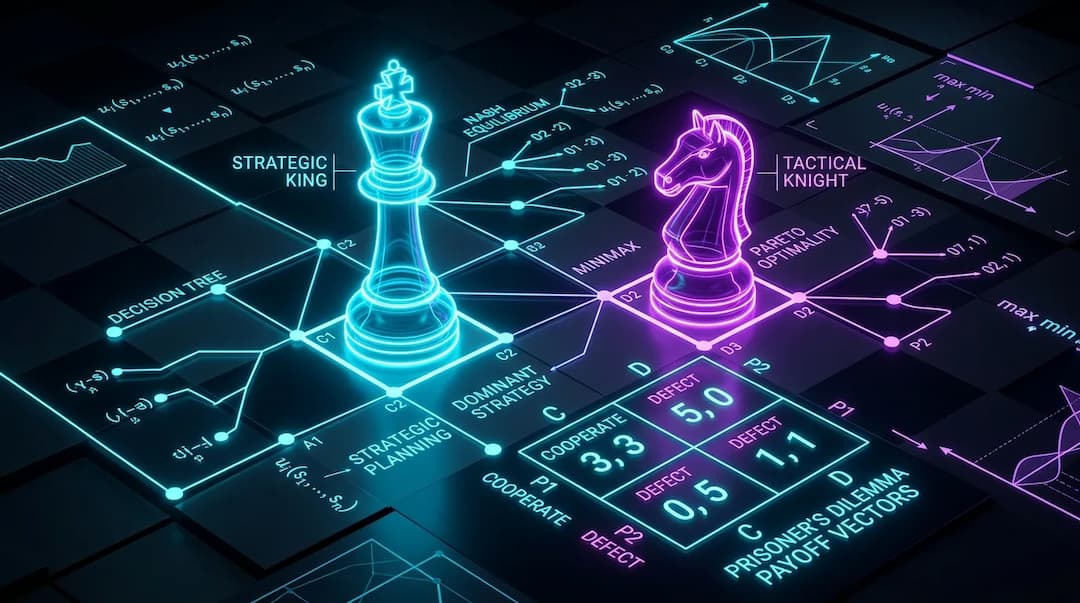
Introduction
In traditional economics, decision-makers are assumed to operate in isolation against a passive environment—calculating supply, demand, and risk like a sailor reading the weather. However, in real life, business, diplomacy, and romance, you are not playing against nature; you are playing against **other active, intelligent minds** whose choices depend on what they think you will do.
This is the domain of **Game Theory**: the mathematical framework for understanding strategic interdependence. Developed by polymath **John von Neumann** and brought to Nobel Prize-winning maturity by **John Nash**, game theory provides rigorous analytical models for price wars, international nuclear deterrence, corporate mergers, and auction mechanics.
Below is QuizOxa’s **25-scenario Game Theory Diagnostic**, organized across four progressive strategic tiers: The Prisoner’s Dilemma & Cooperation, Nash Equilibrium & Mixed Strategies, Bargaining & Credible Commitments, and Information Asymmetry & Market Auctions. Test your tactical acumen and study the mathematical rationales behind every scenario.
The 5 Foundational Archetypes of Game Theory
Almost all complex geopolitical negotiations and corporate competitive dynamics can be reduced to five fundamental mathematical game structures.
| Classic Game Model | Key Incentive Dynamic | Nash Equilibrium Outcome | Real-World Strategic Example |
|---|---|---|---|
| Prisoner’s Dilemma | Individual incentive to defect undermines the mutual cooperative optimum | Both players defect (sub-optimal mutual penalty) | OPEC oil production quotas, advertising spending wars, corporate price cutting |
| Stag Hunt | Mutual cooperation yields massive prize; defecting guarantees a small, safe meal | Two equilibria: Mutual Stag (payoff dominant) or Mutual Hare (risk dominant) | Adopting new open-source software frameworks, joint space exploration |
| Chicken / Hawk-Dove | Catastrophic mutual destruction if both persist; concession yields zero status | Asymmetric equilibria: one player bluffs/charges while the other swerves | Union strike deadlines, sovereign debt default negotiations, trade tariff threats |
| Battle of the Sexes | Both players prefer coordinating on any venue rather than being apart, but disagree on location | Two pure equilibria where players coordinate on one preferred option | Standardization wars (e.g. VHS vs Betamax, USB-C vs Lightning, EV charging plugs) |
| Matching Pennies | Pure conflict: Player 1 wins if coins match; Player 2 wins if coins mismatch | Zero pure Nash equilibria; stable only in 50/50 mixed randomized strategies | Goalkeeper vs penalty kicker in soccer, cyber-attackers vs network firewalls |
Since 1994, more than a dozen Nobel Memorial Prizes in Economic Sciences have been awarded for game theory breakthroughs, including John Nash, Thomas Schelling, Robert Aumann, Elinor Ostrom, and Paul Milgrom.
Zero-Sum vs Positive-Sum Games: Payoff Dynamics
The single most costly strategic mistake in negotiation is treating an expandable, positive-sum collaboration as a fixed-pie, zero-sum war.
| Strategic Dimension | Zero-Sum Game | Positive-Sum (Non-Zero-Sum) Game | Mastery Rule for Leaders |
|---|---|---|---|
| Payoff Structure | Net sum of utilities equals zero; your gain strictly equals opponent's loss | Net sum of utilities exceeds zero; total pie expands through coordination | Identify whether resources are mathematically fixed or expandable before negotiating |
| Player Relationship | Strictly antagonistic, adversarial, and competitive | Interdependent, collaborative, or competitively cooperative ("coopetition") | Transform zero-sum deadlocks by introducing multi-issue asymmetric trades |
| Communication Role | Deceptive, guarded, or non-existent; cheap talk is completely ignored | Critical for establishing trust, verifying compliance, and aligning expectations | Credible commitments must carry verifiable downside cost to be believable |
| Classic Domain | Poker tournaments, boxing championships, chess, fixed market-share splits | Global trade treaties, corporate mergers, team workflow delegation, marriage | Never treat a positive-sum partnership as a zero-sum territorial war |
In 1994, the U.S. Federal Communications Commission hired game theorists to design the Simultaneous Multiple-Round Auction for telecommunications radio spectrum, raising over $120 billion for taxpayers while preventing predatory collusion.
Round 1: Prisoner’s Dilemma, Cooperation & Tit-for-Tat (Q1–6)
Why does individual rational self-interest lead to collective disaster? Explore strictly dominant strategies, repeated interactions, and the math of sustained cooperation.
Incentive Alignment & Repeated Interaction Dynamics
Two rival smartphone companies (Alpha & Beta) are setting ad budgets. If both spend $5M, both maintain current sales. If Alpha spends $20M while Beta spends $5M, Alpha steals 40% market share. If both spend $20M, they cancel each other out and waste $15M each. Why do both companies inevitably choose to spend $20M?
Von Neumann originally developed zero-sum game theory while attempting to find a mathematically unexploitable strategy for bluffing in poker, proving that deceptive randomization is required for equilibrium.
Round 2: Nash Equilibrium & Dominant Strategies (Q7–12)
Explore strategic stability where no player has any incentive to unilaterally defect. Master pure vs mixed strategies in Stag Hunt, Battle of the Sexes, and penalty kicks.
Strategic Stability, Mixed Strategies & Minimax Theorem
What is the exact definition of a "Nash Equilibrium" in non-cooperative game theory?
Biologist John Maynard Smith applied game theory to evolutionary biology with the concept of the Evolutionarily Stable Strategy (ESS), explaining why male animals stage ritualized displays rather than fighting to the death.
Round 3: Bargaining, Credible Commitments & Brinkmanship (Q13–19)
How do you make an adversary believe an ultimatum? Study Schelling focal points, burning bridges, BATNA leverage, and irrationality as a calculated weapon.
Bargaining Leverage, Credible Threats & Commitment Devices
In the game of "Chicken" (two drivers speeding toward each other on a single-lane bridge), how can Driver 1 credibly force Driver 2 to swerve and concede?
Round 4: Information Asymmetry, Signaling & Market Auctions (Q20–25)
When one party knows more than the other, markets distort. Master Akerlof’s lemon problem, Spence signaling, Vickrey second-price auctions, and the Winner’s Curse.
Information Economics, Auction Design & Adverse Selection
In George Akerlof’s Nobel Prize-winning paper "The Market for Lemons," why does Information Asymmetry cause used car markets to unravel and collapse?
Surprising Mathematical & Strategic Facts
Fascinating discoveries from the intersection of mathematics and human behavior
In Martin Shubik’s Dollar Auction, a $1 bill is auctioned with the rule that the second-highest bidder must also pay their bid. Bidders consistently escalate past $1, often paying $3 to $5 for a single dollar to avoid being the second-place loser.
In rock-paper-scissors or penalty kicks, if a human plays non-random patterns, an AI algorithm can predict moves with >70% accuracy within 20 rounds. True randomness is the only mathematically unbeatable defense.
In transportation network game theory, mathematician Dietrich Braess proved that adding a new highway to a congested road network can cause all commuters’ travel times to increase, as self-interested drivers create new bottlenecks.
Economist Alvin Roth designed market-clearing kidney exchange algorithms using cooperative game theory matching mechanisms, saving thousands of lives without monetary transactions.