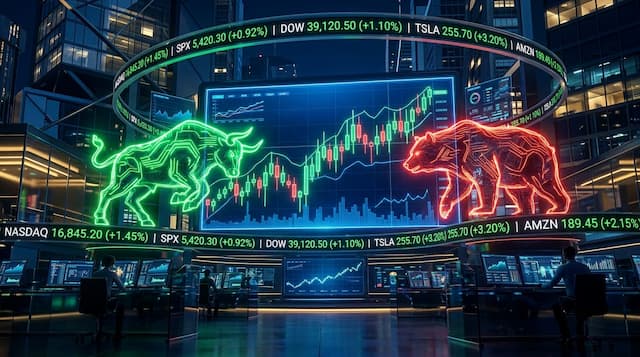
Stock Market Quiz β 50 Questions
From Sensex fundamentals to Black Swan events, 50 stock market questions that test whether you truly understand how markets work. Whether you are a beginner investor or seasoned trader, every answer includes detailed explanations with real-world examples.
π What's Inside
Why Stock Market Knowledge Matters
The Indian stock market has over 10 crore unique investor accounts as of 2024, up from just 4 crore in 2020. Yet surveys consistently show that most retail investors lack basic market literacy, leading to poor investment decisions, panic selling during downturns, and vulnerability to scams.
Understanding how markets work does not require a finance degree. It requires knowing the fundamentals β what stocks are, how exchanges operate, what drives prices, and how to evaluate risk. This quiz covers all of these essentials and more.
Round 1: Stock Market Fundamentals
Before you trade your first share, you need to understand the building blocks of the stock market. This round covers exchanges, indices, accounts, and the basic concepts every investor should know before putting money at risk.
Q1. What is a stock exchange?
β Answer: A regulated marketplace where securities (stocks, bonds, derivatives) are bought and sold
Stock exchanges provide a transparent, regulated platform for buying and selling securities. The world's first stock exchange was established in Amsterdam in 1602 by the Dutch East India Company. Major exchanges include NYSE, NASDAQ, BSE (Bombay Stock Exchange, Asia's oldest, est. 1875), and NSE (National Stock Exchange of India).
Q2. What is the Sensex?
β Answer: The benchmark index of the Bombay Stock Exchange (BSE), tracking 30 large-cap Indian companies
The Sensex (Sensitive Index) was created in 1986 with a base value of 100. It tracks 30 of India's largest and most liquid companies across sectors. Major Sensex companies include Reliance Industries, TCS, HDFC Bank, Infosys, and ITC. The Sensex crossed 70,000 points for the first time in December 2023.
Q3. What is the Nifty 50?
β Answer: The benchmark index of the National Stock Exchange (NSE), comprising 50 large-cap companies
The Nifty 50 was launched in 1996 and represents approximately 65% of the total market capitalisation of the NSE. It covers 13 sectors of the Indian economy. The Nifty 50 is used as a benchmark by most Indian mutual funds and is the basis for the most traded derivatives in India.
Q4. What is a market capitalisation?
β Answer: The total market value of a company's outstanding shares (Share Price Γ Total Shares)
Market cap categorises companies: Large-cap (top 100 by market cap, e.g., Reliance, TCS), Mid-cap (101stβ250th), and Small-cap (251st onward). As of 2024, Reliance Industries is India's most valuable company by market cap (over βΉ19 lakh crore). Globally, Apple was the first company to reach $3 trillion.
Q5. What is SEBI?
β Answer: Securities and Exchange Board of India β the regulatory body for the Indian securities market
SEBI was established in 1988 and given statutory powers in 1992 through the SEBI Act. It regulates stock exchanges, mutual funds, brokers, and listed companies to protect investors and ensure fair markets. SEBI's equivalent in the US is the SEC (Securities and Exchange Commission).
Q6. What is a demat account?
β Answer: A dematerialised account that holds shares and securities in electronic form
In India, you need a demat account to buy or sell shares on stock exchanges. NSDL and CDSL are the two depositories that maintain demat accounts. Before dematerialisation (1996), shares were traded as physical paper certificates. Today, brokers like Zerodha, Groww, and Angel One offer free demat accounts.
Q7. What does "going long" vs "going short" mean?
β Answer: Going long means buying a stock expecting it to rise; going short means selling a borrowed stock expecting it to fall
Most retail investors "go long" β they buy shares hoping the price will increase. "Going short" (short selling) profits from declining prices. In India, delivery-based short selling must be covered by end of day, while futures and options allow longer-term short positions. Successful investors like George Soros have made billions by going short.
Round 2: Investing Legends & Strategies
Learn from the masters. This round tests your knowledge of legendary investors, proven investment strategies, and the philosophies that have created billions in wealth over decades of disciplined investing.
Q1. Who is Warren Buffett?
β Answer: The CEO of Berkshire Hathaway, widely regarded as the greatest investor of all time
Known as the "Oracle of Omaha," Warren Buffett is a value investor who has achieved approximately 20% average annual returns since 1965. He advocates buying "wonderful companies at a fair price" and holding them long-term. He has pledged to donate 99% of his wealth (over $100 billion) to charity.
Q2. What is a P/E ratio?
β Answer: Price-to-Earnings ratio β the share price divided by earnings per share (EPS)
The P/E ratio is the most common stock valuation metric. A P/E of 25 means investors pay βΉ25 for every βΉ1 of earnings. High P/E stocks (like IT companies, P/E 30β50) are expected to grow fast. Low P/E stocks (like PSU banks, P/E 5β10) may be undervalued or have slower growth prospects.
Q3. What is a dividend?
β Answer: A portion of a company's profits distributed to shareholders
Dividends are typically paid quarterly or annually. Companies like ITC, Coal India, and Hindustan Zinc are known for high dividend yields in India. The dividend yield is calculated as (Annual Dividend per Share Γ· Share Price) Γ 100. A 5% dividend yield means you earn βΉ5,000 annually for every βΉ1,00,000 invested.
Q4. What does "Blue Chip" stock mean?
β Answer: Shares of large, well-established companies with a history of stable earnings and dividends
The term "Blue Chip" comes from poker, where blue chips have the highest value. Indian blue chips include Reliance, TCS, HDFC Bank, Infosys, and HUL. In the US, Apple, Microsoft, Johnson & Johnson, and Coca-Cola are classic blue chips. These stocks are considered safer but may offer slower growth than mid or small-cap stocks.
Q5. What is the "Efficient Market Hypothesis"?
β Answer: The theory that stock prices reflect all available information, making it impossible to consistently "beat the market"
Proposed by economist Eugene Fama, the EMH argues that stocks always trade at their fair value on exchanges, making it impossible for investors to consistently achieve above-average returns through analysis or market timing. Index fund advocates like Jack Bogle used this theory to argue that most investors should simply buy the market.
Q6. What is dollar-cost averaging (DCA)?
β Answer: Investing a fixed amount at regular intervals regardless of market price
DCA is essentially what SIP does in India. By investing βΉ10,000 every month, you buy more units when prices are low and fewer when prices are high. Over time, this averages out the cost per unit and reduces the impact of market volatility. Studies show DCA outperforms lump-sum investing during volatile markets.
Q7. What is a "dead cat bounce"?
β Answer: A brief recovery in the price of a declining stock, followed by a continuation of the downward trend
The morbid phrase implies that "even a dead cat will bounce if it falls from a great height." A dead cat bounce tricks some investors into thinking the worst is over, but the recovery is temporary. Identifying whether a price rebound is a genuine reversal or a dead cat bounce is one of the most challenging aspects of market analysis.
Q8. What is a sovereign wealth fund?
β Answer: A state-owned investment fund that invests in real assets like stocks, bonds, real estate, and other financial instruments
The world's largest sovereign wealth funds include Norway's Government Pension Fund ($1.4 trillion), Abu Dhabi Investment Authority ($990 billion), and China Investment Corporation ($1.2 trillion). These funds are typically funded by commodity revenues (oil/gas) or trade surpluses. India does not have a traditional sovereign wealth fund but NIIF (National Investment and Infrastructure Fund) serves a similar purpose.
Round 3: Trading Mechanics & Market Instruments
The mechanics of how markets operate are essential knowledge for any active trader. This round covers order types, derivatives, margin trading, and the technical tools traders use to analyse price movements.
Q1. What is an ETF (Exchange-Traded Fund)?
β Answer: A basket of securities that trades on a stock exchange like a single stock
ETFs combine the diversification of mutual funds with the trading flexibility of stocks. You can buy and sell ETFs throughout the day at market prices. Popular Indian ETFs include Nifty 50 ETFs, Gold ETFs, and Bank Nifty ETFs. ETFs typically have lower expense ratios than actively managed mutual funds.
Q2. What is the difference between fundamental and technical analysis?
β Answer: Fundamental analysis evaluates a company's intrinsic value; technical analysis studies price charts and patterns
Fundamental analysts study financial statements, revenue, profit margins, and competitive advantages to determine if a stock is overvalued or undervalued. Technical analysts use price charts, moving averages, RSI, and candlestick patterns to predict short-term price movements. Most professional investors use a combination of both.
Q3. What is a stop-loss order?
β Answer: An order to sell a stock automatically when it reaches a specified price to limit losses
If you buy a stock at βΉ500 and set a stop-loss at βΉ450, the stock will automatically be sold if the price drops to βΉ450, limiting your loss to 10%. Stop-loss orders are essential risk management tools, especially for traders. Without stop-losses, a 50% loss requires a 100% gain just to break even.
Q4. What is short selling?
β Answer: Selling borrowed shares with the intention of buying them back at a lower price to profit from a decline
In short selling, you borrow shares from a broker, sell them at the current price, and hope to buy them back cheaper later. If the stock falls from βΉ500 to βΉ400, you profit βΉ100 per share. However, losses are theoretically unlimited if the stock rises. In India, naked short selling is only allowed intraday.
Q5. What is a candlestick chart?
β Answer: A type of financial chart that shows the open, high, low, and close prices for a security over a specific period
Candlestick charts originated in 18th-century Japan for trading rice. Each "candle" shows four prices: the opening price, highest price, lowest price, and closing price. A green (or white) candle means the price closed higher than it opened; a red (or black) candle means it closed lower. Patterns like "Doji," "Hammer," and "Engulfing" help traders predict future price movements.
Q6. What is the difference between a limit order and a market order?
β Answer: A market order executes immediately at the current price; a limit order only executes at your specified price or better
Market orders guarantee execution but not price β in volatile markets, you might get a worse price than expected (slippage). Limit orders guarantee price but not execution β your order may never fill if the stock does not reach your limit price. Long-term investors typically use market orders; traders often prefer limit orders for precision.
Q7. What is margin trading?
β Answer: Borrowing money from a broker to buy more shares than you can afford with your own capital
If you have βΉ1,00,000 and your broker offers 2x margin, you can buy βΉ2,00,000 worth of shares. If the stock rises 10%, you earn 20% on your capital (βΉ20,000 instead of βΉ10,000). But if it falls 10%, you lose 20%. Margin trading amplifies both profits and losses and can result in a "margin call" where the broker forces you to add funds or sell.
Q8. What is an option contract?
β Answer: A derivative that gives the buyer the right, but not the obligation, to buy (call) or sell (put) an asset at a specified price before a certain date
Options are powerful but complex instruments. A call option gives you the right to buy; a put option gives you the right to sell. In India, Nifty and Bank Nifty options are the most heavily traded derivatives in the world by volume. Options trading requires understanding of concepts like strike price, premium, expiry date, and the Greeks (delta, gamma, theta, vega).
Q9. What is a "52-week high/low"?
β Answer: The highest and lowest prices at which a stock has traded during the past 52 weeks (one year)
The 52-week high/low is a widely watched indicator. Stocks trading near their 52-week high are seen as having strong momentum. Stocks near their 52-week low may be undervalued or facing problems. Breakouts above the 52-week high often signal further upside. This data is published daily by all stock exchanges.
Q10. What is the "bid-ask spread"?
β Answer: The difference between the highest price a buyer is willing to pay (bid) and the lowest price a seller will accept (ask)
A tight bid-ask spread (e.g., βΉ499.95 bid, βΉ500.05 ask) indicates high liquidity β the stock is easy to buy or sell. A wide spread (e.g., βΉ495 bid, βΉ505 ask) indicates low liquidity and higher trading costs. Blue-chip stocks typically have very tight spreads, while small-cap stocks may have wider spreads.
Q11. What is the "Fear and Greed Index"?
β Answer: A market sentiment indicator that measures whether investors are being fearful (bearish) or greedy (bullish)
CNN's Fear and Greed Index uses 7 indicators including market momentum, stock price breadth, put/call ratio, and junk bond demand to generate a score from 0 (extreme fear) to 100 (extreme greed). Legendary investors often say "be greedy when others are fearful, and fearful when others are greedy" β a quote attributed to Warren Buffett.
Round 4: Indian Markets & Regulations
India has one of the fastest-growing capital markets in the world. This round tests your knowledge of SEBI regulations, Indian indices, FII/DII dynamics, and tax-saving investment instruments unique to the Indian market.
Q1. What does "IPO" stand for?
β Answer: Initial Public Offering β the first time a company sells shares to the public
An IPO is how private companies become publicly traded. The company works with investment banks (underwriters) to set the offer price. India saw massive IPOs like LIC (βΉ21,000 crore in 2022), Zomato, and Paytm. Globally, Saudi Aramco's $25.6 billion IPO in 2019 remains the largest ever.
Q2. What is a bull market?
β Answer: A market condition where stock prices are rising or expected to rise, typically by 20% or more
Bull markets are characterised by investor optimism, economic growth, and rising corporate profits. The longest bull market in US history ran from March 2009 to February 2020 (nearly 11 years). The term is believed to come from the way a bull attacks β thrusting its horns upward.
Q3. What is a bear market?
β Answer: A market condition where stock prices fall 20% or more from recent highs
Bear markets are driven by pessimism, economic slowdown, and falling corporate earnings. The 2008 Global Financial Crisis saw the Sensex crash from 21,000 to 8,000 (a 62% decline). The average bear market lasts about 9.6 months, compared to the average bull market lasting about 2.7 years.
Q4. What is a mutual fund NAV?
β Answer: Net Asset Value β the per-unit price of a mutual fund, calculated as (Total Assets β Liabilities) Γ· Number of Units
NAV is calculated at the end of each trading day. If a fund has assets worth βΉ100 crore and 10 crore units outstanding, the NAV is βΉ10. When you invest βΉ10,000 at NAV βΉ10, you get 1,000 units. A common misconception is that a "low NAV" fund is cheaper β NAV does not indicate value, only unit price.
Q5. What is a stock market circuit breaker?
β Answer: An automatic trading halt triggered when markets move beyond specified limits to prevent panic
In India, SEBI's circuit breaker system halts trading for 15 minutes to 2 hours if the Sensex or Nifty moves by 10%, 15%, or 20% in either direction. This prevents panic selling or buying. Circuit breakers were triggered globally in March 2020 during the COVID-19 market crash.
Q6. What is FII and DII?
β Answer: FII = Foreign Institutional Investors; DII = Domestic Institutional Investors
FIIs are foreign entities (mutual funds, pension funds, hedge funds) that invest in Indian markets. DIIs include Indian mutual funds, insurance companies (LIC), and banks. FII and DII activity is closely watched because their buying/selling patterns significantly influence market direction. When FIIs sell heavily, markets often decline; DII buying provides support.
Q7. What is ELSS (Equity Linked Savings Scheme)?
β Answer: A type of mutual fund that offers tax deductions under Section 80C with a 3-year lock-in period
ELSS is the only mutual fund category that qualifies for tax deduction under Section 80C (up to βΉ1,50,000). It has the shortest lock-in period (3 years) among all 80C investments. ELSS funds invest primarily in equities, offering potentially higher returns than other tax-saving options like PPF or NSC, but with market risk.
Q8. What is the difference between equity and debt mutual funds?
β Answer: Equity funds invest primarily in stocks; debt funds invest in bonds, government securities, and fixed-income instruments
Equity funds offer higher potential returns (12β15% CAGR historically) but with higher volatility. Debt funds offer lower but more stable returns (6β8%) with lower risk. Tax treatment also differs β equity fund gains (held 1+ year) are taxed at 10% above βΉ1 lakh, while debt fund gains are taxed at the investor's income tax slab rate.
Q9. What is the role of the RBI in the stock market?
β Answer: The Reserve Bank of India sets monetary policy (interest rates, repo rate) which influences market liquidity and investor sentiment
While SEBI directly regulates stock markets, the RBI's monetary policy decisions profoundly impact them. When the RBI cuts the repo rate, borrowing becomes cheaper, companies can expand more easily, and stocks tend to rise. When rates increase, borrowing costs rise, slowing economic activity and often pressuring stock prices downward.
Round 5: Market History & Advanced Concepts
Markets have a rich history of booms, busts, and innovation. This round explores famous market events, behavioural finance concepts, and advanced instruments that separate casual observers from serious market participants.
Q1. What is a stock split?
β Answer: A corporate action that divides existing shares into multiple new shares, reducing the per-share price proportionally
In a 2:1 stock split, each share worth βΉ1,000 becomes two shares worth βΉ500 each. Your total investment value does not change. Companies split stocks to make shares more affordable for retail investors. MRF, with a share price above βΉ1,00,000, is a famous example of a company that has never split its stock.
Q2. What is the Dow Jones Industrial Average (DJIA)?
β Answer: A US stock market index that tracks 30 large publicly-owned companies
Created by Charles Dow in 1896, the DJIA is one of the oldest and most-watched indices in the world. Unlike the S&P 500 (which is market-cap weighted), the Dow is price-weighted β higher-priced stocks have more influence. Companies in the Dow include Apple, Microsoft, Goldman Sachs, and McDonald's.
Q3. What is the S&P 500?
β Answer: A stock market index tracking the 500 largest publicly traded companies in the United States
The S&P 500 is considered the best single gauge of the US stock market. It covers approximately 80% of US market capitalisation. Warren Buffett recommends that most investors simply invest in an S&P 500 index fund. The index has returned an average of approximately 10% per year since its inception in 1957.
Q4. What is NASDAQ?
β Answer: The National Association of Securities Dealers Automated Quotations β the world's first electronic stock market
Founded in 1971, NASDAQ is known for listing technology companies. It is home to Apple, Microsoft, Amazon, Google (Alphabet), Meta, and Tesla. The NASDAQ Composite index tracks all stocks listed on the exchange (over 3,000 companies). NASDAQ is the second-largest stock exchange in the world by market capitalisation.
Q5. What is insider trading?
β Answer: The illegal practice of trading stocks based on material, non-public information
Insider trading occurs when someone with access to confidential information (like upcoming earnings, mergers, or product launches) trades on that knowledge before it becomes public. SEBI and the SEC actively investigate and prosecute insider trading. Penalties include heavy fines and imprisonment.
Q6. What caused the 2008 Global Financial Crisis?
β Answer: The collapse of the US housing bubble, driven by subprime mortgages and excessive financial leverage
Banks gave risky home loans (subprime mortgages) to borrowers who could not afford them. These loans were packaged into complex securities (CDOs) and sold to investors worldwide. When homeowners defaulted, the entire financial system nearly collapsed. Lehman Brothers went bankrupt, global stock markets crashed, and governments spent trillions on bailouts.
Q7. What is the "January Effect" in stock markets?
β Answer: A seasonal tendency for stock prices to rise in January, particularly small-cap stocks
The January Effect theory suggests that stock prices, especially small-caps, tend to increase in January. This may be due to year-end tax-loss harvesting (selling losing stocks in December for tax benefits, then reinvesting in January) and fresh annual investment allocations. However, the effect has weakened in recent decades as more investors are aware of it.
Q8. What is a REIT (Real Estate Investment Trust)?
β Answer: A company that owns, operates, or finances income-generating real estate and distributes at least 90% of taxable income as dividends
REITs allow retail investors to invest in commercial real estate without buying property. India's first REIT (Embassy Office Parks) was listed in 2019. REITs invest in office spaces, malls, warehouses, and hotels. They offer regular dividend income and are regulated by SEBI. Global REITs manage over $4 trillion in assets.
Q9. What is a "Black Swan" event in financial markets?
β Answer: An extremely rare, unpredictable event with severe consequences for the markets
The term was popularised by Nassim Nicholas Taleb in his 2007 book "The Black Swan." Examples include the 2008 financial crisis, the COVID-19 pandemic crash, and 9/11. Black Swan events are impossible to predict with standard models. Taleb argues that people systematically underestimate the probability and impact of such events.
Q10. What is algorithmic (algo) trading?
β Answer: Using computer programs and algorithms to automatically execute trades based on predefined rules
Algo trading accounts for 50β70% of total trading volume on Indian stock exchanges and up to 80% on US exchanges. Algorithms can execute trades in milliseconds, analyse thousands of data points simultaneously, and remove emotional decision-making. Common strategies include high-frequency trading (HFT), arbitrage, and trend-following.
Q11. What was the Dot-com Bubble?
β Answer: A speculative stock market bubble (1995β2000) driven by excessive investment in internet-based companies
During the dot-com era, investors poured money into internet startups with no profits, revenues, or viable business models. The NASDAQ rose from 1,000 in 1995 to over 5,000 in March 2000, then crashed, losing nearly 80% of its value by October 2002. Companies like Pets.com, Webvan, and eToys went bankrupt. The crash wiped out $5 trillion in market value.
Q12. What is a "penny stock"?
β Answer: A share of a small company that trades at a very low price, typically below βΉ10 in India or below $5 in the US
Penny stocks are highly speculative and volatile. They can deliver massive gains (multibagger returns) but also total loss. They are often targeted by pump-and-dump schemes where manipulators artificially inflate the price and then sell. SEBI places additional trading restrictions on some penny stocks to protect retail investors.
Q13. What is corporate governance?
β Answer: The system of rules, practices, and processes by which a company is directed and controlled
Good corporate governance ensures transparency, accountability, and fair treatment of shareholders. India's corporate governance framework is based on the Companies Act 2013, SEBI (LODR) Regulations, and Clause 49 requirements. The Satyam scandal (2009), where the chairman fabricated βΉ7,000 crore in cash reserves, is India's most infamous corporate governance failure.
Q14. What is the difference between BSE and NSE?
β Answer: BSE (Bombay Stock Exchange) is Asia's oldest exchange (est. 1875); NSE (National Stock Exchange) is newer (est. 1992) but dominates trading volume
BSE has more listed companies (5,000+) but NSE handles about 90% of India's equity derivative trading volume. BSE's benchmark is the Sensex (30 stocks); NSE's is the Nifty 50 (50 stocks). Most stocks are listed on both exchanges. NSE's electronic trading system, launched in 1994, revolutionised Indian capital markets by replacing the open-outcry system.
Q15. What is a "multibagger" stock?
β Answer: A stock that returns multiple times its original investment β e.g., a 10-bagger returns 10x your investment
The term was coined by legendary fund manager Peter Lynch in his book "One Up on Wall Street." Indian multibaggers include Eicher Motors (Royal Enfield), which grew over 100x from 2009 to 2017, and Bajaj Finance, which returned over 50x in a decade. Identifying multibaggers early requires understanding growth potential, competitive advantages, and management quality.
Tips for Beginner Investors
- Start with index funds β Warren Buffett recommends them for most investors. Low cost, broad diversification, and historically superior returns vs active funds.
- Never invest money you cannot afford to lose β Build an emergency fund first, then invest surplus. Markets can drop 30β50% in a crash.
- Use SIPs to remove emotion β Investing a fixed amount monthly removes the temptation to time the market, which even professionals fail at consistently.
- Learn to read basic financial statements β Revenue, profit, debt, and cash flow are the four numbers that tell you 80% of what you need to know about a company.
- Be patient β The stock market is a wealth-building machine over 10β20 years, but a casino over days and weeks. Time in the market beats timing the market.
Frequently Asked Questions
β What is the largest stock exchange in the world by market capitalisation?
β The New York Stock Exchange (NYSE) is the largest stock exchange in the world by market capitalisation, with a total market cap exceeding $25 trillion. It is located on Wall Street in New York City and was founded in 1792.
β Who is considered the greatest investor of all time?
β Warren Buffett, the "Oracle of Omaha," is widely regarded as the greatest investor of all time. As CEO of Berkshire Hathaway, he has achieved average annual returns of approximately 20% since 1965, turning the company into one of the most valuable in the world.
β What is a stock market index?
β A stock market index is a statistical measure that tracks the performance of a specific group of stocks. Examples include the Sensex (30 stocks on BSE), Nifty 50 (50 stocks on NSE), S&P 500 (500 US stocks), and Dow Jones Industrial Average (30 major US companies).
Test More Knowledge on QuizOxa
QuizOxa offers hundreds of free questions across Science, History, Football, Geography, and General Knowledge, with real-time timers, streak bonuses, and global leaderboards.
Our editorial team researches, writes, and fact-checks every article and quiz question. We reference established scholarly, scientific, and educational sources to ensure accuracy.