Introduction
Choosing a career is one of the most consequential decisions of your life, yet many people stumble into one by accident: following family expectations, taking whatever was available, or realizing years later that they picked the wrong path. Over a working life of 40-plus years, most people spend tens of thousands of hours at work, so fit matters.
A career fit quiz changes that by assessing your interests, skills, values, and personality. The best-known framework is psychologist John Holland’s RIASEC model, which shows that satisfaction is highest when your personality matches your work environment.
This guide explores six career personality types, maps them to Holland’s codes, highlights common career mistakes, and shows how to change direction at any age. Test yourself along the way with 20 interactive questions.
1. Why Career Fit Matters: Holland’s RIASEC Model
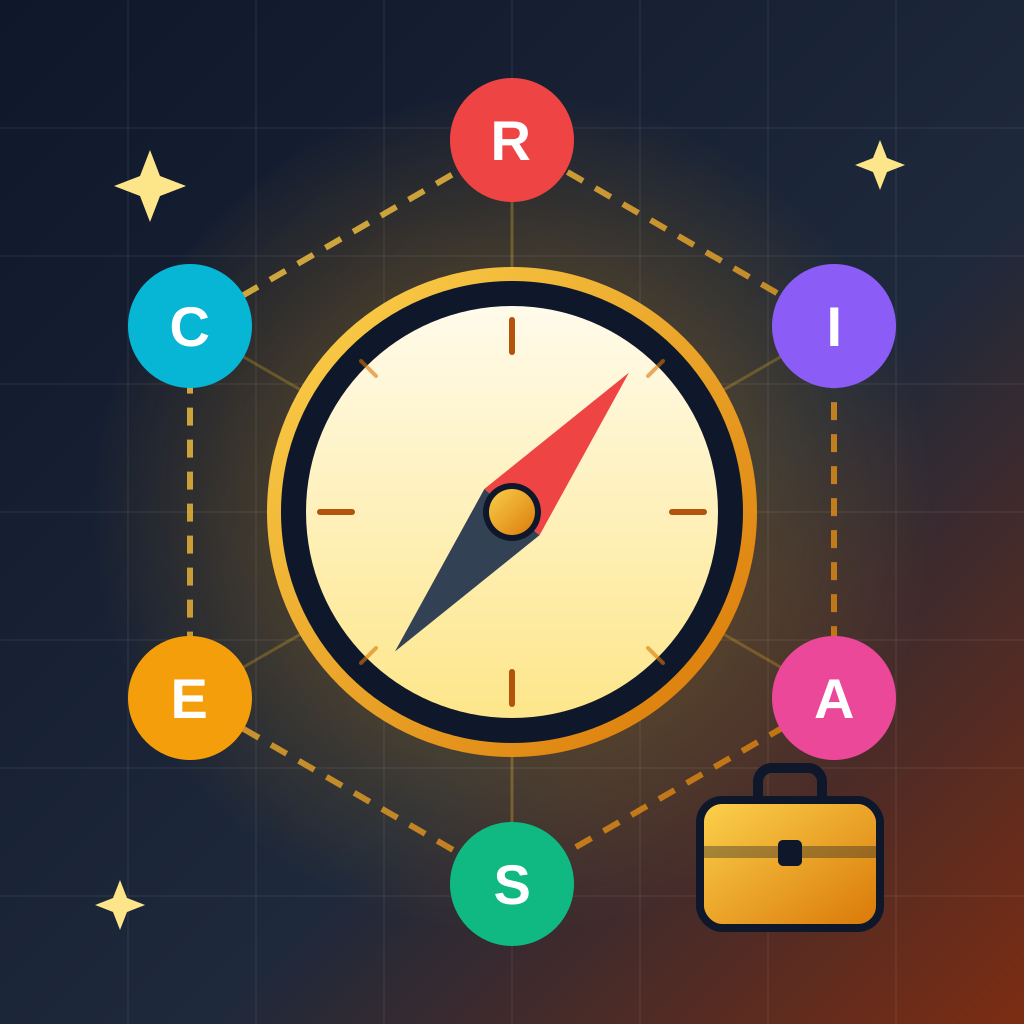
Holland’s core idea is simple: people and work environments can both be described by six types, Realistic, Investigative, Artistic, Social, Enterprising, and Conventional. When your type matches your environment, work stops feeling like a chore and starts feeling like an expression of who you are.
The types sit on a hexagon. Neighbors such as Investigative and Artistic share a lot, while opposites such as Realistic and Social share little. That is why a natural mechanic may feel drained in a counseling role, and vice versa.
Round 1: 5 Questions on Holland Codes, the RIASEC Hexagon & Congruence
Which psychologist created the RIASEC model of six career interest types?
Career counselors usually summarize you with your top three RIASEC types, in order. Two people who are both "Social" can thrive in very different jobs if one is SAE (teacher, counselor) and the other is SEC (HR manager, school administrator).
The 6 Career Personality Types: Which One Are You?
Most people are a blend, but one type usually dominates. As you read, notice which description resonates most deeply, and which feels most draining.
The Innovator loves inventing and improving systems and is comfortable with risk. The Leader inspires teams, plans strategically, and makes tough calls. The Analyst breaks complex problems down with logic and data. The Helper is empathetic and motivated by improving lives. The Performer is a charismatic communicator energized by an audience. The Explorer craves variety, autonomy, and constant learning.
| Career Type | Closest Holland Codes | Core Drive | Example Careers | Watch Out For |
|---|---|---|---|---|
| The Innovator | Artistic + Investigative | Create something new | Product manager, UX designer, architect, startup founder, game developer | Starting many ideas and finishing few |
| The Leader | Enterprising | Influence and direct | Operations manager, project manager, sales director, nonprofit director | Overlooking the people doing the work |
| The Analyst | Investigative + Conventional | Understand and solve | Data scientist, financial analyst, actuary, software developer, researcher | Analysis paralysis and isolation |
| The Helper | Social | Support and develop others | Nurse, teacher, counselor, social worker, HR specialist, coach | Compassion fatigue and weak boundaries |
| The Performer | Enterprising + Artistic | Express and persuade | Marketing manager, journalist, podcast host, trainer, event manager | Tying self-worth to applause |
| The Explorer | Realistic + Investigative | Discover and experience | Field scientist, environmental specialist, consultant, photographer, guide | Restlessness that blocks deep expertise |
Edward K. Strong Jr. published his Strong Vocational Interest Blank in 1927. It compared people’s likes and dislikes with those of satisfied workers in each field, an approach still used in the modern Strong Interest Inventory.
2. Find Your Type: Interests, Strengths & Ideal Work Environments
A good career assessment looks at five things: interests (which activities energize you), skills (what comes easily), values (money, flexibility, impact, creativity), work style (structured or flexible, solo or team, fast or methodical), and the environment you thrive in.
Use the questions below to see how each career type plays out in real roles. If two types feel equally true, that is normal: hybrid profiles such as Analyst-Innovator or Helper-Performer often point to the most satisfying niche careers.
Round 2: 5 Questions Matching Career Types to Real Jobs & Environments
The Analyst type thrives on logic, patterns, and data-driven decisions. Which career is the strongest natural fit?
Krumboltz’s Planned Happenstance research found that unplanned events, such as a conversation, a side project, or a chance job posting, shape most career paths. Curiosity and openness turn luck into opportunity.
3. The Science of Career Satisfaction & Performance
Decades of vocational psychology show that interests predict satisfaction, while traits such as conscientiousness predict performance. Motivation research adds a third piece: people stay engaged when work offers autonomy, mastery, and connection.
Free, validated tools make this science accessible. The U.S. Department of Labor’s O*NET Interest Profiler gives you a Holland code and links it to detailed occupation profiles, so you can compare tasks, required skills, and job outlook side by side.
Round 3: 5 Questions on Big Five, Motivation Science & Career Assessments
Which Big Five personality trait most consistently predicts job performance across nearly all occupations?
Donald Super observed that adults "recycle" through the exploration stage at major transitions. Mid-life pivots are a normal part of career development, not a sign of failure.
Avoid These Common Career Mistakes
Even with a clear career type, a few predictable traps derail people. Here is what to do instead:
| Common Mistake | Better Move | Why It Backfires |
|---|---|---|
| Choosing by salary alone | Shortlist careers that fit you, then compare pay | High pay rarely offsets daily work you dislike |
| Following family expectations | Get input, then make your own decision | You, not your family, live the 9-to-5 every day |
| Waiting for the "perfect" path | Choose a direction and adjust as you learn | Clarity comes from action, not endless research |
| Ignoring your strengths | Build on what comes naturally | Fixing weaknesses yields average results at best |
| Never re-evaluating | Reassess every few years or at big transitions | You change, and your work should change with you |
| Staying loyal to a bad fit | Plan a deliberate, staged exit | Sunk-cost thinking keeps you stuck for years |
4. Career Transitions: It’s Never Too Late
Ages 18–25: the perfect time to explore. Try different roles before committing and build broad skills. Ages 26–35: leverage your experience, explore adjacent industries, and take on stretch projects; your skills transfer more than you think.
Ages 36–50: use your reputation and network, and consider consulting, mentoring, or launching your own venture. 50+: many people start successful second careers in consulting, board roles, nonprofit leadership, or part-time work that combines passion with experience.
Round 4: 5 Questions on Career Change, Planned Happenstance & Future-Proof Skills
Which career theory, proposed by John Krumboltz and colleagues, encourages people to create and act on unplanned opportunities?
Surprising Facts About Careers & Work
A few things most people never learn in school:
A full-time career of 40 years at about 40 hours a week adds up to well over 80,000 hours, which is why small improvements in fit compound into big differences in wellbeing.
Ikigai means "a reason for being" in Japanese, but the famous four-circle chart linking passion, skill, need, and pay was popularized in the West in 2014.
The U.S. Department of Labor’s O*NET database describes the tasks, skills, knowledge, and work styles of hundreds of occupations, and every profile is tagged with RIASEC interest codes.
Being organized, reliable, and persistent is the Big Five trait most consistently linked to job performance across occupations, from engineering to sales to management.