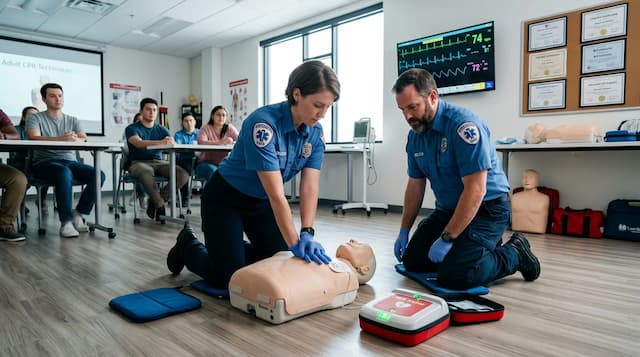
Introduction
Cardiopulmonary Resuscitation (CPR) and Basic Life Support (BLS) are the gold standards of emergency cardiac intervention. Every year, over 350,000 out-of-hospital sudden cardiac arrests occur in the United States alone. Immediate, high-quality CPR performed within the first two minutes can double or triple a patient's survival rate.
Whether you are an aspiring nurse, EMT, physician, dental provider, lifeguard, fitness instructor, or workplace safety officer preparing for your American Heart Association (AHA) or American Red Cross certification renewal, achieving a passing score of 84%+ requires mastery of depth, rates, ratios, and AED algorithms.
Below is a comprehensive 50-question CPR & BLS practice examination based on the latest 2026 international resuscitation standards. Review each question, test your recall, and read the clinical explanations to ensure complete certification readiness!
Round 1: Adult Basic Life Support (BLS) & High-Quality CPR
Master core adult parameters: the C-A-B sequence, 100-120 BPM tempo, 2-2.4 inch depth, full recoil, pulse check duration, and Chest Compression Fraction (CCF).
| Patient Category | Compression Depth | Hand Technique | 1-Rescuer vs 2-Rescuer Ratio |
|---|---|---|---|
| Adult (Puberty & older) | At least 2 inches (5-6 cm) | 2 hands interlocked on lower half of sternum | 30:2 (Both 1 & 2 rescuers) |
| Child (1 year to puberty) | About 2 inches (1/3 chest depth) | 2 hands or 1 hand on lower half of sternum | 30:2 (1 rescuer) / 15:2 (2 rescuers) |
| Infant (Under 1 year) | About 1.5 inches (1/3 chest depth) | 2 fingers (1 rescuer) or 2 thumbs-encircling (2 rescuers) | 30:2 (1 rescuer) / 15:2 (2 rescuers) |
| Advanced Airway Placed | According to age standard | Continuous compressions at 100-120 BPM | 1 breath every 6 seconds (10 breaths/min) |
Adult Resuscitation · 10 Interactive Questions
What is the correct sequence of emergency action steps in the AHA Basic Life Support protocol?
Every 60-second delay in delivering a defibrillation shock to a victim in Ventricular Fibrillation reduces their chance of survival by 7% to 10%! Immediate bystander CPR slows this decline dramatically.
Round 2: Automated External Defibrillator (AED) Operations
Understand early defibrillation: anterolateral pad vector, identifying shockable rhythms (V-Fib/pVT), wet skin, pacemakers, and medication patches.
Defibrillation & Electricity · 10 Interactive Questions
What is the very first step when an Automated External Defibrillator (AED) arrives at the victim’s side?
The beat of the classic 1977 disco song "Stayin' Alive" by the Bee Gees is almost exactly 103 beats per minute—fitting precisely within the optimal 100-120 BPM resuscitation window recommended worldwide!
Round 3: Pediatric & Infant Basic Life Support
Address pediatric arrests: 15:2 two-rescuer ratios, the two thumb-encircling grip, brachial pulse checks, 1/3 chest depth, and compression for bradycardia <60 BPM.
Infant & Child BLS · 10 Interactive Questions
What is the age definition of a "child" versus an "infant" in resuscitation guidelines?
Round 4: Foreign Body Airway Obstruction (Choking)
Emergency airway clearance: Heimlich abdominal thrusts, pregnant chest thrusts, infant 5-back-slap/5-chest-thrust cycles, and unconscious choking CPR.
Airway Obstruction · 10 Interactive Questions
What is the universal distress signal for foreign-body airway obstruction (choking)?
Round 5: Advanced Scenarios, ETCO2 Capnography & Team Dynamics
High-performance code management: advanced airway asynchronous ventilation, compressor 2-minute rotation, waveform capnography (>10 vs 35-40 mmHg ROSC), and H’s & T’s.
Advanced Code Protocols · 10 Interactive Questions
Once an advanced airway (endotracheal tube or supraglottic airway) is placed during CPR, how do ventilations change?
4 Proven Strategies to Pass Your CPR / BLS Certification on the First Try
Follow these proven study techniques to easily score 90%+ on exam day:
Adults: always 30:2 (1 or 2 rescuers). Children/Infants: 30:2 for 1 rescuer, but drops to 15:2 for 2 rescuers. Advanced airway: continuous compressions + 1 breath every 6s.
AEDs ONLY shock Ventricular Fibrillation (V-Fib) and Pulseless Ventricular Tachycardia (pVT). They do NOT shock Asystole (flatline) or Pulseless Electrical Activity (PEA).
Leaning on the manikin chest is the #1 reason students fail physical skills assessments. Completely lift your palms between compressions.
Never exceed 10 seconds when assessing pulse and breathing. If uncertain whether a pulse is present by second 10, initiate compressions immediately.